Why Magnetic Destoners Are Essential for Grain Processing Plants

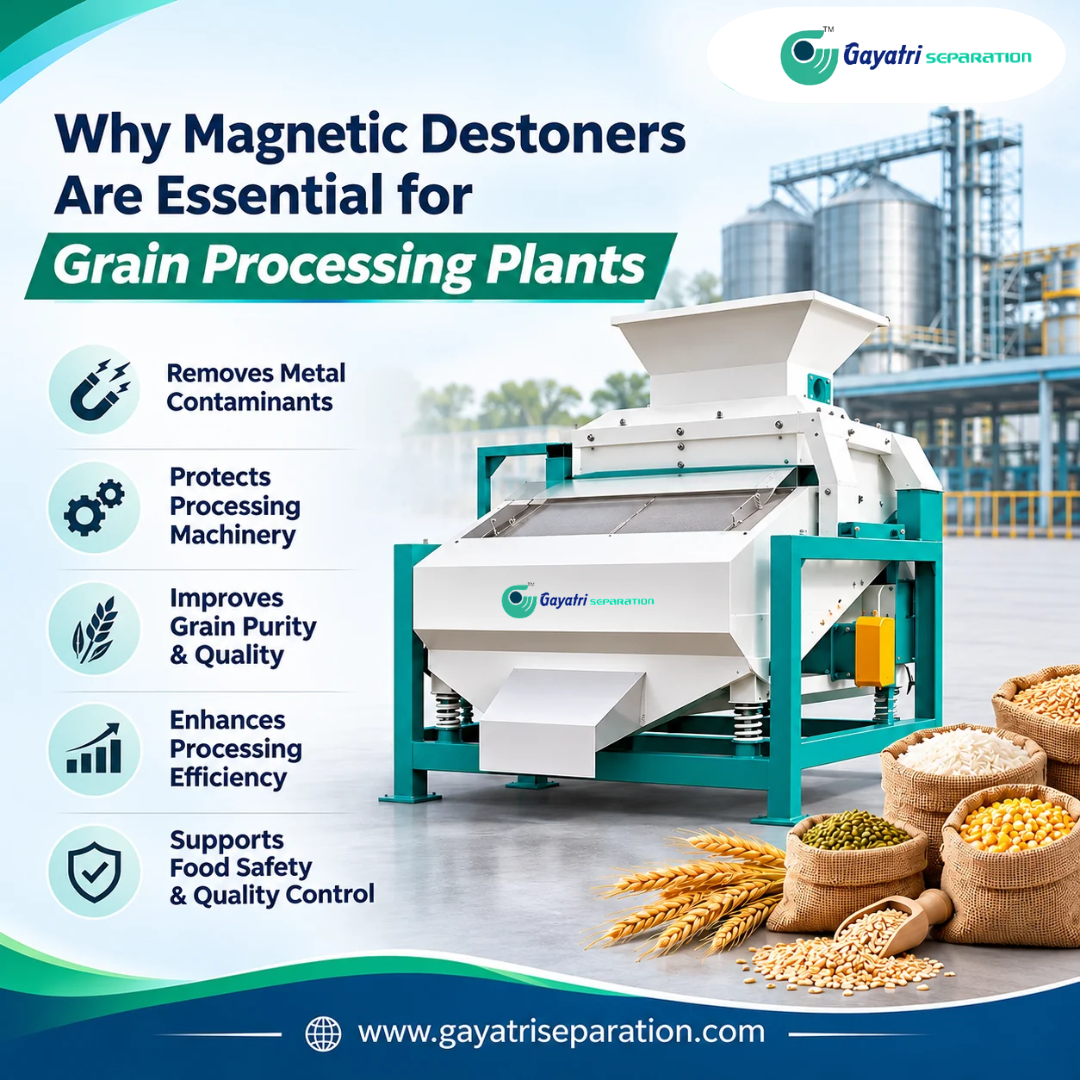
Magnetic Destoner for Grains
Grain processing plants handle large volumes of agricultural materials every day. From rice and wheat to maize, pulses and seeds, raw grains often contain unwanted impurities that can affect product quality, damage processing machinery and interrupt production operations. Removing these contaminants before further processing is an important step in maintaining consistent product quality and efficient plant operations.
This is where a magnetic destoner for grain processing plants becomes an important piece of industrial equipment. It helps separate metallic contaminants and other unwanted heavy impurities from grain materials through a combination of magnetic separation, vibration and gravity-based separation, depending on the machine design.
Whether it is a rice mill, wheat flour mill, pulse processing unit or large-scale grain cleaning facility, an effective destoning system can support cleaner raw materials, protect downstream equipment and improve processing efficiency.
In this article, we will explore how magnetic destoners work, why they are important for grain processing plants, their industrial applications and the factors to consider when selecting the right machine.
What Is a Magnetic Destoner Machine?
A magnetic destoner machine is industrial separation equipment designed to remove unwanted impurities from grains, seeds, pulses and other bulk materials. It combines magnetic separation with mechanical and gravity-based separation mechanisms to separate magnetic contaminants and other targeted impurities from the main product stream.
During harvesting, transportation and storage, grains can become mixed with stones, mud balls, glass fragments, iron particles and other foreign materials. If these impurities are not removed before processing, they can affect the quality of the finished product and cause damage to milling and processing equipment.
Magnetic destoners are commonly used in rice mills, wheat processing plants, maize processing units, pulse mills and food processing industries.
Unlike conventional screening equipment that primarily separates materials based on particle size, a magnetic destoner can use differences in magnetic properties, weight and material behaviour to improve impurity separation.
Main Components of a Magnetic Destoner
A magnetic destoner generally consists of several components that work together to achieve effective separation. The exact configuration depends on the machine design and application.
1. Feed Hopper and Feeding System
The feed hopper receives raw grains and directs them towards the separation section. A controlled feeding mechanism helps distribute the material evenly for consistent processing.
2. Vibratory Feeder
The vibratory feeder controls the movement and distribution of grains across the processing surface. Consistent feeding helps maintain stable material flow and supports effective separation.
3. Magnetic Roller or Magnetic Separation Unit
The magnetic assembly generates a magnetic field that attracts and retains magnetic contaminants from the material stream. Its configuration and magnetic strength depend on the separation requirements.
4. Conveyor Belt
In conveyor-based designs, the belt transports the material through the magnetic separation zone. Magnetic particles are retained by the magnetic roller while non-magnetic material follows a different discharge path.
5. Separation Deck
The separation deck supports the movement of material during the separation process. Its vibration and, where provided, controlled airflow help separate particles based on their physical characteristics.
6. Collection and Discharge Outlets
Separate outlets collect the cleaned product and rejected impurities, allowing the processing line to continue with the next stage.
Types of Impurities Removed by Magnetic Destoners
Depending on the machine configuration and separation mechanism, magnetic destoners can help remove different types of unwanted materials, including:
- Iron particles and ferrous metal fragments.
- Magnetically responsive impurities.
- Iron-rich stones and certain metallic contaminants.
- Mud balls and other heavy impurities.
- Stones and glass fragments through suitable gravity-based separation mechanisms.
It is important to understand that ordinary stones and non-magnetic foreign materials cannot be attracted by magnets. Their separation requires suitable mechanical, gravity or density-based mechanisms within the equipment.
How Does a Magnetic Destoner Work in Grain Processing?
A magnetic destoner works through a combination of magnetic separation, controlled material feeding, vibration and gravity-based separation. The objective is to separate unwanted contaminants from grains while maintaining a consistent flow of usable material.
The working process generally involves the following stages.
Feeding and Material Distribution
Raw grains enter the machine through the feed hopper. The feeding system distributes the material across the conveyor belt or separation deck.
Uniform material distribution is important because uneven feeding can affect separation efficiency. A controlled flow allows the machine to process incoming material more consistently.
Magnetic Separation of Metallic Impurities
As the material passes through the magnetic separation zone, magnetic particles are attracted towards the magnetic assembly.
In conveyor-based magnetic destoners, magnetic particles adhere to the belt around the magnetic roller, while non-magnetic particles follow a different discharge path.
This process helps remove iron particles and other magnetically responsive contaminants from the grain stream.
Vibration and Gravity-Based Separation
The separation deck uses controlled vibration to move the material. Depending on the machine configuration, airflow and gravity also help separate lighter grains from heavier contaminants.
Differences in particle density, size and movement behaviour allow the equipment to direct different materials towards separate outlets.
This is particularly useful when processing grains containing stones, mud balls and other heavy impurities.
Collection and Discharge of Separated Contaminants
After separation, the cleaned grain and rejected impurities are discharged through designated outlets.
The cleaned material can then move to the next processing stage, such as milling, polishing, grading, packaging or storage.
The overall effectiveness depends on factors such as grain characteristics, feed rate, moisture content, machine settings and the type of contaminants present.
Why Are Magnetic Destoners Essential for Grain Processing Plants?
Grain processing plants require reliable cleaning systems to maintain product quality and protect expensive production equipment. A magnetic destoner supports these requirements by helping remove unwanted impurities before grains enter further processing stages.
Here are the major reasons why magnetic destoners are important for modern grain processing operations.
Removal of Unwanted Metal Contaminants
Metal contamination can enter grain materials during harvesting, transportation, storage and handling. Small iron fragments, metallic particles and other magnetic contaminants may remain mixed with raw agricultural materials.
When contaminated grains enter processing equipment, these particles can affect product quality and create operational concerns.
A magnetic destoner helps capture magnetic contaminants during the cleaning process, reducing the amount of unwanted metallic material moving further into the production line.
Protection of Milling and Processing Machinery
Grain processing plants use equipment such as mills, rollers, grinders, conveyors and other mechanical systems. Unwanted stones and metallic contaminants can cause wear, damage and unexpected interruptions.
Removing these impurities before they reach downstream machinery helps reduce the risk of equipment damage.
For example, cleaning wheat before milling can help prevent stones and other heavy contaminants from entering grinding equipment.
This can support smoother production operations and reduce avoidable maintenance requirements.
Improved Grain Purity and Product Quality
Product quality is an important consideration for grain processors. Consumers, food manufacturers and distributors expect grains and processed food ingredients to meet consistent quality requirements.
Magnetic destoners help improve raw material cleanliness by separating targeted contaminants before further processing.
Cleaner input materials can support better milling, grading and packaging operations. However, the final product quality also depends on other cleaning, sorting and quality control processes used throughout the plant.
Reduced Equipment Wear and Maintenance Requirements
Foreign materials can increase the mechanical load on processing equipment. Hard contaminants such as stones may cause wear to grinding components, rollers and other machine parts.
By removing targeted impurities earlier in the production process, magnetic destoners can help reduce unnecessary stress on downstream equipment.
This can contribute to fewer contamination-related maintenance issues and better equipment utilisation.
Better Processing Efficiency and Production Continuity
Unwanted impurities can interrupt production when they accumulate inside machinery or cause operational problems.
A properly selected magnetic destoner helps maintain cleaner material flow and supports the overall grain cleaning process.
When integrated correctly into the production line, it can reduce manual impurity removal requirements and support more consistent processing operations.
Support for Food Safety and Quality Control
Food processing businesses must maintain suitable hygiene and contamination control practices throughout their operations.
Magnetic destoners provide an additional separation step that helps remove magnetic contaminants and other targeted impurities from raw grain materials.
They should be used as part of a broader quality management system that includes raw material inspection, sieving, cleaning, storage controls and appropriate product testing.
Applications of Magnetic Destoners in the Grain Processing Industry
Magnetic destoners are used across several agricultural and food processing applications. Their ability to handle different bulk materials makes them useful for businesses involved in grain cleaning and impurity separation.
Rice Mills and Paddy Processing Plants
Rice processing facilities receive paddy that may contain stones, mud balls, iron particles and other unwanted materials.
Before milling, paddy must undergo suitable cleaning and separation processes to prepare it for further operations.
Magnetic destoners help remove magnetic contaminants and, through their combined separation mechanisms, can assist in separating other heavy impurities.
This helps protect downstream rice milling equipment and supports better raw material cleanliness.
Wheat Flour Mills
Wheat flour mills process large quantities of wheat to produce flour for bakeries, food manufacturers and other applications.
During handling and transportation, wheat may become contaminated with stones, metallic particles and other foreign materials.
Installing suitable destoning equipment in the grain cleaning section helps remove these contaminants before wheat enters the milling process.
This supports equipment protection and helps maintain the quality of the raw material used for flour production.
Maize and Corn Processing Plants
Maize and corn are processed into flour, grits, starch and other food ingredients.
These processing operations require effective cleaning because unwanted foreign materials can affect the final product and damage processing machinery.
Magnetic destoners can help separate magnetic contaminants and other targeted impurities from maize before further processing.
Pulses and Lentil Processing Units
Pulse processing plants handle materials such as chickpeas, lentils, beans and peas.
Raw pulses may contain stones, mud balls, metallic fragments and other impurities that need to be removed before grading and packaging.
Magnetic destoners help improve the cleaning process by separating unwanted contaminants according to the machine’s magnetic and physical separation capabilities.
Seed Cleaning and Grain Handling Facilities
Seed cleaning and grain handling facilities require suitable equipment to maintain the cleanliness of agricultural materials before storage, distribution or further processing.
Magnetic destoners can be integrated into suitable cleaning lines to remove targeted impurities from seeds and grains.
They are particularly useful where businesses handle multiple agricultural materials and require equipment configured according to their specific processing requirements.
Magnetic Destoner vs Conventional Grain Cleaning Equipment
Different types of grain cleaning equipment perform different separation functions. Understanding these differences helps processing plants select the right machinery for their operations.
A magnetic destoner is not a replacement for every grain cleaning machine. Instead, it complements other equipment within a complete cleaning and separation system.
| Equipment | Primary Function | Typical Application |
|---|---|---|
| Magnetic Destoner | Combines magnetic and physical separation mechanisms to remove targeted impurities | Grain and food processing |
| Gravity Destoner | Separates heavier impurities based on density differences | Rice, wheat and pulses |
| Vibro Screen | Separates materials according to particle size | Grain grading and screening |
| Magnetic Separator | Removes ferrous and other magnetically responsive contaminants | Industrial material cleaning |
| Air Separator | Separates lighter impurities using controlled airflow | Grain cleaning and dust removal |
For example, a rice processing plant may use a vibro screen for size-based screening, an air separator for lighter impurities and a destoner for heavy contaminants. Magnetic separation can provide an additional step for removing metallic impurities.
Using suitable equipment at different stages helps create a more effective grain cleaning process.
Factors to Consider When Choosing a Magnetic Destoner for Grain Processing
Selecting the right magnetic destoner is important for achieving effective separation and maintaining consistent production operations.
Before purchasing equipment, grain processing businesses should evaluate their material characteristics, production requirements and installation conditions.
Grain Type and Material Characteristics
Different grains have different physical properties, including particle size, density, moisture content and flow behaviour.
A machine suitable for wheat processing may require different operating settings or configuration when used for rice, maize or pulses.
Discuss the type of material and contamination level with the equipment manufacturer before finalising a machine.
Processing Capacity and Material Flow Rate
The machine should be selected according to the plant’s required processing capacity.
An undersized machine may create a production bottleneck, while an unnecessarily large machine can increase investment costs.
Consider the required hourly throughput, feeding conditions and integration with existing processing equipment.
Magnetic Strength and Separation Requirements
Magnetic strength is an important factor when removing ferrous and magnetically responsive contaminants.
The appropriate magnetic configuration depends on the type, size and quantity of contaminants present in the material.
Processing businesses should discuss their separation objectives and sample material with the manufacturer to identify a suitable magnetic system.
Machine Design and Construction Quality
Industrial grain processing equipment should be designed for regular operation and the conditions in which it will be installed.
Consider the quality of construction materials, conveyor belt durability, vibration system, magnetic assembly and accessibility for maintenance.
A suitable design can help maintain consistent operation and reduce unnecessary downtime.
Maintenance and Cleaning Requirements
Regular inspection and maintenance are important for maintaining machine performance.
Before purchasing, understand the cleaning procedure, inspection requirements, availability of spare parts and maintenance support offered by the manufacturer.
Equipment that is easier to inspect and maintain can support more convenient plant operations.
Manufacturer Experience and After-Sales Support
Choosing an experienced manufacturer can make a significant difference during machine selection, installation and operation.
Look for a manufacturer that understands industrial separation requirements and can recommend suitable equipment based on your material and processing capacity.
Technical guidance, customisation options, installation support and spare parts availability are also important considerations.
Why Choose Gayatri Separation for Magnetic Destoner Machines?
Selecting the right magnetic separation equipment requires a manufacturer with practical knowledge of industrial applications and product requirements.
Gayatri Separation, established in 1992, is a magnetic equipment manufacturer, supplier and exporter based in Ahmedabad, Gujarat, India. The company offers a range of industrial magnetic equipment designed for different material separation and processing applications.
Its product portfolio includes magnetic destoners, magnetic roller separators, magnetic grills, vibro screens, gyro screens, magnetic pulleys, plate magnets and other magnetic separation solutions.
Gayatri Separation focuses on product quality, equipment reliability and customised solutions to meet different industrial requirements.
Its magnetic destoner range is designed to combine magnetic separation with vibration and gravity-based separation for handling materials such as rice, wheat, maize, seeds, pulses and other food processing products.
The company also highlights features such as controlled material feeding, adjustable deck oscillation and magnetic separation configurations to support different processing requirements.
Whether you operate a rice mill, wheat flour mill, pulse processing facility or food manufacturing unit, selecting suitable equipment is important for maintaining effective impurity separation.
Explore the Magnetic Destoner Machine from Gayatri Separation to learn more about its equipment and applications.
You can also explore the company’s magnetic roller separator solutions for industrial magnetic separation requirements.
To understand the company’s manufacturing background and engineering capabilities, visit the About Gayatri Separation page.
Looking for a suitable magnetic destoner for your grain processing plant?
Contact Gayatri Separation to discuss your material type, processing capacity and impurity removal requirements. The team can help you identify a suitable magnetic separation solution for your application.
Visit Gayatri Separation to explore its industrial magnetic equipment range or contact the team for an enquiry.
Conclusion
Magnetic destoners play an important role in modern grain processing plants by helping remove magnetic contaminants and other targeted impurities from agricultural materials.
From rice mills and wheat flour mills to maize processing plants and pulse cleaning facilities, these machines support cleaner raw materials, protect downstream equipment and contribute to efficient production operations.
However, selecting the right machine requires an understanding of grain characteristics, contamination levels, production capacity and the separation mechanisms required for the application.
For grain processing businesses looking to improve their cleaning operations, investing in suitable magnetic separation equipment can be a valuable step towards better product quality and more reliable processing.
Working with an experienced manufacturer such as Gayatri Separation can help businesses identify equipment that meets their specific material handling and separation requirements.
Frequently Asked Questions
1. What is the purpose of a magnetic destoner in grain processing?
A magnetic destoner helps remove magnetic contaminants and other targeted impurities from grains and agricultural materials. It combines magnetic separation with physical separation mechanisms to improve raw material cleanliness and protect downstream processing equipment.
2. How does a magnetic destoner remove impurities from grains?
A magnetic destoner uses magnetic fields to attract and retain magnetic contaminants. Depending on its design, vibration, gravity and airflow can also help separate heavier impurities such as stones and mud balls from grains.
3. Which grains can be processed using a magnetic destoner?
Magnetic destoners are used for different agricultural materials, including rice, wheat, maize, pulses, lentils, beans, peas and seeds. The machine configuration should be selected according to the material characteristics and processing requirements.
4. What is the difference between a magnetic destoner and a gravity destoner?
A magnetic destoner combines magnetic separation with other physical separation mechanisms to remove magnetic contaminants and targeted heavy impurities. A conventional gravity destoner primarily separates heavier materials from grains based on density differences using airflow and vibration.
5. How does a magnetic destoner protect grain processing machinery?
By removing targeted metal contaminants, stones and other heavy impurities before they reach downstream equipment, a magnetic destoner can help reduce the risk of damage to rollers, grinders, milling machines and other processing components.
6. How do I choose the right magnetic destoner for my processing plant?
Consider your grain type, processing capacity, impurity characteristics, magnetic separation requirements, machine construction, maintenance needs and available installation space. Discussing these factors with an experienced manufacturer can help identify the right machine configuration.
7. Is a magnetic destoner suitable for rice and wheat mills?
Yes. Magnetic destoners are used in rice and wheat processing facilities to help remove magnetic contaminants and other targeted impurities before further processing. Their suitability depends on the material characteristics, machine design and required separation performance.
About Gayatri Separation
Gayatri Separation is a magnetic equipment manufacturer, supplier and exporter based in Ahmedabad, Gujarat, India. Established in 1992, the company offers magnetic destoners, magnetic roller separators, magnetic grills, vibro screens and other industrial magnetic separation equipment for different processing applications.
Website: https://gayatriseparation.com/